Introduction and Demographics
Vietnam is a country in Southeastern Asia, officially the Socialist Republic of Vietnam, with a population of 97,040,334. It has one of the highest population densities in the world. The reason Vietnam has become such a populated country with a rapidly expanding market economy is due to the absorption and adaptation of other civilization’s ideas, institutions, and technology (Hickey). There are fifty-four ethnic groups recognized by the Viatnamese Government (The World Factbook: Vietnam). Vietnam is full of diverse cultural traditions, geographies, and historical events (Hickey). Vietnamese is the official language and English is becoming favored as a second language. As of 2009 81.8% of the country identified as non-religious with the highest percentage identifying as Buddhist at 7.9%. In Vietnam, like many Asian countries, there is a gender imbalance where there is a 1.1 male to female ratio.

Hickey, Gerald C., et al. “Vietnam.” Encyclopædia Britannica, Encyclopædia Britannica, Inc., 7 Feb. 2019, www.britannica.com/place/Vietnam.
The World Factbook: Vietnam.” Central Intelligence Agency, Central Intelligence Agency, 1 Feb. 2018, www.cia.gov/library/publications/the-world-factbook/geos/vm.html.
Political and Economic Context
The Socialist Republic of Vietnam is a one-party state ruled by the Đảng Cộng sản Việt Nam —Communist Party of Vietnam. Concerning gender equality, the Communist Party has taken concrete governmental actions to promote it since 1945. For example, Article 9 of the First Constitution (1946) of the country states: “All power in the country belongs to the Vietnamese people, irrespective of race, sex, fortune, class, religion…” and that “women are equal to men in all respects” (UN Women 15). In 2015 the government approved the National Action Program on Gender Equality over the 2016-2020 period, which aims to reduce gender gaps and empower women in different sectors, industries, regions, and localities. Despite government efforts, women are still at disadvantage in many respects. For example, younger retirement age for women has led to discrimination of women in the workforce, but it is precisely because of those efforts that many Vietnamese people believe that gender equality has already been achieved in the country thus considering further efforts as unnecesary.
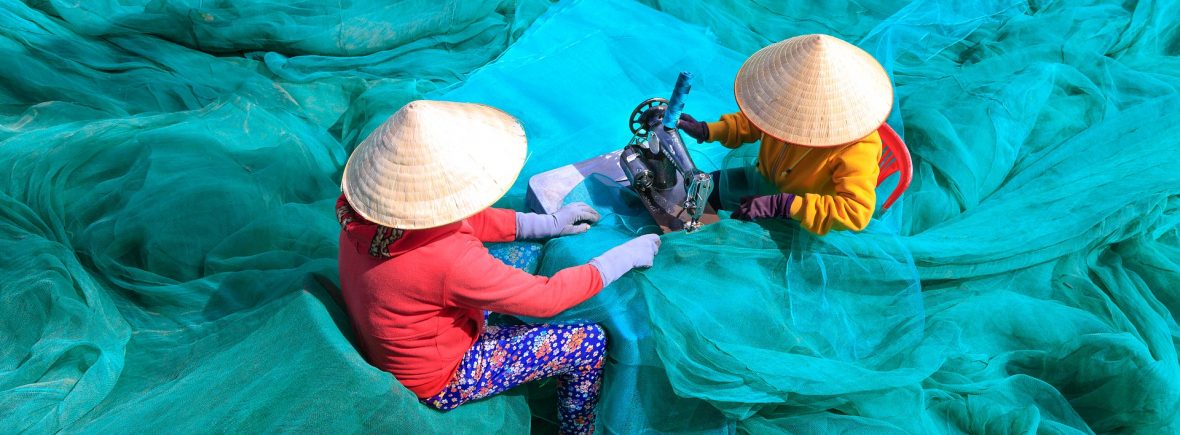
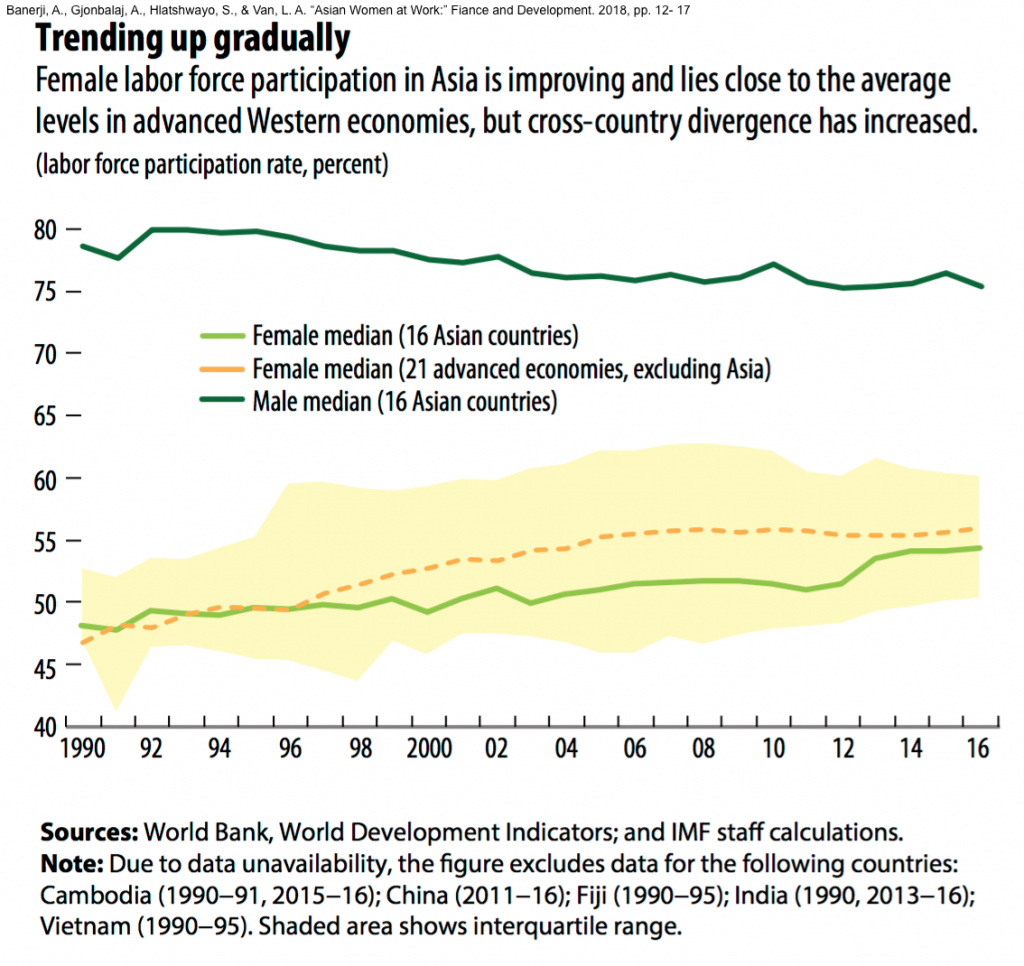
For women, in today’s contemporary Vietnam, there has been a great increase in economic advancements (Kirsty, 2011). Women have become more involved in the workforce, with 76% of women win the labor force working in agriculture and 10% in the textile industry (Banerji et. al, 2018). However, in Vietnam, the gender pay gap is around 13%, due to the Confucian values and ideas that women should still be staying at home doing gender specific duties (Hang, 2008). Nevertheless, there has been an increase in female employment due to economic reforms/growth, push towards education, and gender equality, increase in economic trade, and rapid urbanization (Higgins, 2015).
Banerji, A., Gjonbalaj, A., Hlatshwayo, S., & Van, L. A. “Asian Women at Work:” Fiance and Development. 2018, pp. 12- 17
“Despite high labour force participation rate for women, gender pay gap on the rise”. ilo.org. 7 March 2013. Archived from the original on 10 May 2016. Retrieved 17 June 2016.
“Facts and figures on women and men in Viet Nam 2010-2015.” United Nations Entity for Gender Equality and the Empowerment of Women (UN Women). Ha Noi, Vietnam, 2016. http://www2.unwomen.org/-/media/field%20office%20eseasia/docs/publications/2016/12/thuc-tien-ve-so-lieu-eng.pdf?la=en&vs=5823
Higgins, Rylan (2015-11-01). “Is It My Job to Make Him Care? Middle-Class Women and Gender Inequality in Ho Chi Minh City”. Anthropology of Work Review. 36 (2): 74–86. doi:10.1111/awr.12069. ISSN 1548-1417.
Kelly, Kristy (2011-01-01). “Vietnam case study (preliminary findings): Women in educational leadership and management” (PDF). A Paper Presented During the Gender Equality in Education: Looking Beyond Parity. An IIEP Evidence Based Policy Forum Held in Paris Between: 3–4.
Thi Thuy Hang, Truong. “Women/s Leadership in Vietnam: Opportunities and Challenges.” JSigns: Journal of Women in Culture and Society 34, no. , (2008). 16-21. https://www.journals.uchicago.edu/doi/pdfplus/10.1086/588432
T. V. A. Tran, “The Direct Loan of Capital from the Bank to Development Production and Gender Equality,” Social Sciences (Vietnam), vol. 34 (1992), pp. 25-26.
Colonial and Post-Colonial Experiences
When the French occupied Vietnam, the people, including women, were subjected to colonial violence. As a result, people bear witness to horrendous and differentiated abuse designed by French soldiers along the lines of race, gender, and sexuality. Women were targeted and violated sexually by men. This caused a lot of mental breakdown and trauma due to the roles imposed by colonialism and patriarchy (Fielding). For instance, women experience a sense of displacement due to feeling caught between modernization and cultural traditions. Women also experienced erasure when traditional local temples and monuments were destroyed by the French. Vietnam’s repetitive, prolonged war and poverty have together overshadowed gender issues. Gender equality has become synonymous with nationalism and socialism. According to Duong, it is necessary to revitalize and capitalize cultural identity to advocate gender equality.
Duong, Wendy N. “Gender Equality and Women’s Issues in Vietnam: The Vietnamese Woman—Warrior and Poet.” Pacific Rim Law and Policy Journal Association. Vol. 10 No. 2 https://digital.law.washington.edu/dspace-law/bitstream/handle/1773.1/783/10PacRimLPolyJ191.pdf?sequence=2
Fielding, Maureen Denise. “From Madwomen to Vietnam Veterans: Trauma, Testimony, and Recovery in Post-Colonial Women’s Writing.” Order No. 9966759 University of Massachusetts Amherst, 2000. Ann Arbor: ProQuest. Web. 18 Apr. 2019.
Rydstrom, Helle. “Politics of colonial violence: Gendered atrocities in French occupied Vietnam.” 2015, https://journals.sagepub.com/doi/pdf/10.1177/1350506814538860
Impact of the State on Women’s Movements
There are several factors to take into account when looking at the effect of the state on feminist movements. Over the years, Vietnam has suffered from poverty, prolonged war and the aftermath of war, which has overshadowed gender issues. Some of these wars include: the first Indochina War (1946-1954), the Laotian Civil War (1953-1975), the Vietnam War (1959-1975), and the Cambodian-Vietnamese War (1977-1989). Secondly, there is a major lack of influence of women in policy making and real life enforcement issues, and this is due to the long political approval process and lack of effective enforcement (Duong, 247-248).
Another factor to take into account is that gender equality in Vietnam is sometimes seen as tied explicitly with notions of nationalism and socialism. For example, the Communist Party believes that the socialist movement is the first place where the voice of women’s liberation was born in Vietnam (Duong, 267). Lastly, many contemporary feminist ideas are rejected because of Vietnam’s long history of a matriarchal society. Because many people believe that Vietnam has always been a progressive state in terms of women’s rights, it is difficult for women to advocate for significant change. Examples of female Vietnamese leaders include Queen Duong Van Nga, Queen Y Lan, Queen Tran Thi Dung (Duong, 255-257).
Country’s Relationship with the West
Vietnam declared independence from the French colonial rule in 1945. In 1955, American forces landed in Vietnam, to support the Southern side, for the second Indochina War with the hope of stopping the spread of communism. Unfortunately, the conflict between the South and the North of Vietnam would stretch for decades, killing an estimated 4 million Vietnamese, including 1.3 million civilians (Vietnam War Reference Library, Encyclopedia.com). The widespread destruction of farms and villages forced many peasants to evacuate their homes and move to cities. Furthermore, the severe poverty and destruction of Vietnam left the country susceptible to societal and economical change. After the withdrawal of American troops in 1973, there were an estimated 800,000 orphaned children on the streets of the major cities (Vietnam War Reference Library, Encyclopedia.com), contributing to the overpopulation of the major cities.
However, an eagerness to restore international ties, especially with the United States, came with Vietnam’s major economic reforms in 1986. This also lead to the introduction of a market economy in Vietnam, attracting international investments. In recent years, Vietnam’s relationship with the U.S. has flourished, especially with the younger generations. Nearly 21,000 Vietnamese citizens are studying in the United States, and in 2016, both countries signed a Peace Corps agreement (U.S. Department of State).
Albert, Eleanor. “The Evolution of U.S.–Vietnam Ties.” Council on Foreign Relations, Council on Foreign Relations, www.cfr.org/backgrounder/evolution-us-vietnam-ties.
Duong, Wendy N. “Gender Equality and Women’s Issues in Vietnam: The Vietnamese Woman—Warrior and Poet.” Pacific Rim Law and Policy Journal Association. Vol. 10 No. 2 https://digital.law.washington.edu/dspace-law/bitstream/handle/1773.1/783/10PacRimLPolyJ191.pdf?sequence=2
Hays, Jeffrey. “INTERNATIONAL ISSUES AND FOREIGN RELATIONS IN VIETNAM.”FactsandDetails,factsanddetails.com/southeast-asia/Vietnam/sub5_9f/entry-3453.html.
History.com Editors. “Vietnam War.” History.com, A&E Television Networks, 29 Oct. 2009, www.history.com/topics/vietnam-war/vietnam-war-history.
Pike, John.“Military.”Vietnam-ForeignRelations,
www.globalsecurity.org/military/world/vietnam/forrel.htm.
“The War’s Effect on the Vietnamese Land, and People.”. “The War’s Effect on the Vietnamese Land and People.” Vietnam War Reference Library, Encyclopedia.com, 2019, www.encyclopedia.com/history/encyclopedias-almanacs-transcripts-and-maps/wars-effect-vietnamese-land-and-people.
U.S. Department of State, “U.S. Relations with Vietnam”, Bureau of East Asian and Pacific Affairs, December 11, 2017. https://www.state.gov/r/pa/ei/bgn/4130.htm
“Vietnam War.” History.com, A&E Television Networks, 21 Aug. 2018, www.history.com/topics/vietnam-war.
“WomenWatch – Vietnam National Action Plan.” United Nations, United Nations, www.un.org/womenwatch/confer/beijing/national/vietnam.htm.
