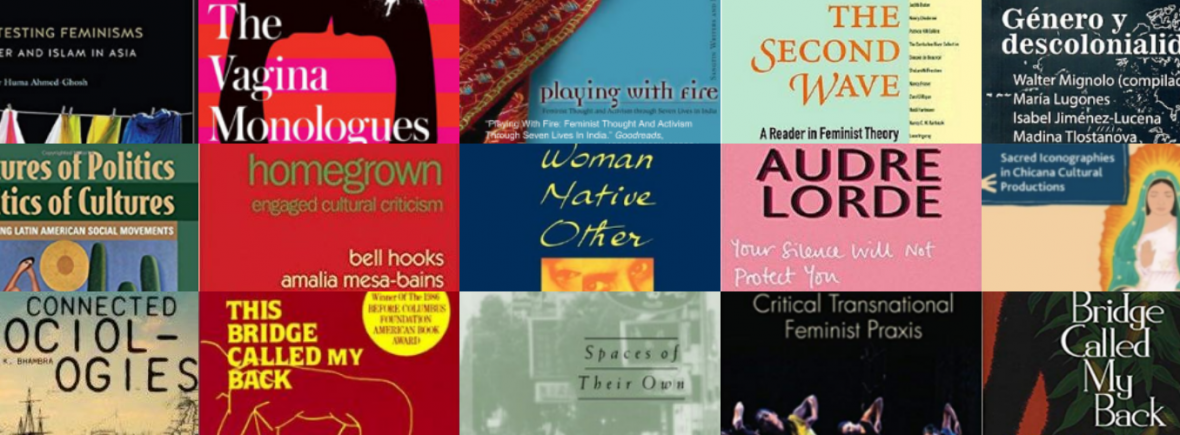
1. “Towards a Decolonial Feminism” by Maria Lugones
According to Maria Lugones, the dichotomous, hierarchical, and categorical logic of modern capitalist and colonial thought must be analyzed through the racialized understanding of gender and power that surged from the European colonization of the Americas. Based on this, colonized people should be understood as historical beings with a double consciousness and agency that resist such impositions through the embracement of heterogeneity in the communitarian process of constructing new ways of being and relating with others.
-Sofía Alpizar Roman ‘21
“What I am proposing in working toward a decolonial feminism is to learn about each other as resisters to the coloniality of gender at the colonial difference, without necessarily being an insider to the worlds of meaning from which resistance to the coloniality arises” (Lugones 753).
Lugones, Maria. “Towards a Decolonial Feminism.” Hypatia. Vol 25 No. 4 (Fall 2010): 742-759.
2. Homegrown: Engaged Cultural Criticism by bell hooks and Amelia Mesa-Bains
Homegrown is a dialogue in which Hooks and Mesa-Bains document the similarities between the Black and Latinx community to show solidarity and to share transnational methodologies. Hooks states, “Homegrown is an expression, it’s a declaration and a bearing witness of that solidarity. It is a denial of the notion, the false assumption that we are not connected” (xiii). In the second half of the text, they focus on the toxicity of the mainstream media, multiculturalism, border relations, memory, and cultural traditions. The dialogue emphasizes the importance of alliances within the communities of people of color and the use of resistance pedagogy to overcome the ethos of domination and patriarchal nationalism.
– Mari Holben ‘22
“We must build enterprises where inter-ethnic intimacy can grow, where we can choose to exchange our histories, our similarities, and our differences without it passing through the purifying, manipulating, and dominating centrality of whiteness” (Mesa-Bains 79).
Homegrown explore different topics and themes related production of knowledge, pedagogies of resistance, multiculturalism and others. The book is a testament of solidarity showing the shared experiences between Black and Latinx women. The reader gains insight into hooks’ and Mesa-Bains’ personal lives through their collaborative storytelling even though they have had different upbringings. The women are able to respectfully disagree while continuing their productive dialogue, which educates the reader on multiple aspects of Black and Latino culture. Homegrown features the importance of discourse between people of different minority groups instead of being pitted against one another.
-Lydia Krumper ‘22
“Mainstream visual images are certainly not radical or visionary. In the world of letters and writing, there has been an expanding sense of Black female icons that people can choose from. But most of the images coming out of the art world-including those produced by Black artists-continue the colonizer-colonized discourse of desire, which is very different than the discourse of freedom” (hooks 26).
bell hooks and Amalia Mesa-Bains. Homegrown. Engaged Cultural Criticism. Cambridge, MA: South End Press, 2006.
3. “Dilemmas of Islamic and Secular Feminists and Feminisms” by Huma Ahmed-Ghosh
Huma Ahmed Ghosh examines ways of contributing to the productive dialogue about the future of Muslim women in Islamic and secular states. Both Islamic and Secular feminisms have limitations that make it difficult for them to achieve their goals of empowering women. Ahmed Ghosh proposes a hybridized version as a way for Islamic and secular feminisms to collaborate and to advance the understanding of lived experiences of Muslim women. All types of feminists must unite to challenge the patriarchy to grant women their rights. A comprehensive review of the local cultural and historical contexts of Muslim women’s lives is vital for building meaningful praxis and impacting implementable policies.
– Sasha (Alexandra) Wilson ‘19
“Hybrid feminists need to look at the reality in society and women’s lived experiences to grasp an understanding of women’s lives, and impact implementable policies and build meaningful praxis.” (Ahmed-Ghosh 114)
Ahmed-Ghosh, Huma. “Dilemmas of Islamic and Secular Feminists and Feminisms.” Journal of International Women’s Studies. Vol 9 No. 3 (2008): 1-19.
4. Playing with Fire: Feminist Thought and Activism through Seven Lives in India by Richa Nagar
Playing with Fire is a collection of autobiographical diaries detailing the lives of seven NGO activists in India. Each woman contributed stories of their childhood, adolescence, marriage(s), political coming of age, triumph, and challenges, which were braided together to form a collective analysis. The book reflects on the nuanced intersectionality of “caste, class, gender, religion, and sociospatial location” (XXII) in the women’s lives and also critiques the hierarchical nature of women’s NGOs. The international alliance that was formed by the authors makes it a unique blending of perspectives that sheds light on women’s experiences and social efforts in India. Overall, it is a great example of how storytelling can be a collective practice and also a form of activism.
-Maggie Grabowski ‘20
“Such a notion of accountability is based on the idea that knowledge must emerge out of sustained, critical dialogues with those who are the subjects of that knowledge. Through these dialogues, the subjects of knowledge become the primary evaluators, critics, and intellectual partners of those who are seen as the experts. Thus, discourses such as ‘empowerment,’ ‘pedagogy,’ and ‘feminist praxis’ are enhanced and enriched as they are collectively theorized, used, critiqued, revised, and reshaped to gain new forms of relevance and resonance across borders” (Nagar XLVII).
The Hindi edition of Playing with Fire (Sangtin Yatra, 2004) sought to reach out to the NGO sector, the teachers and women from the communities in India. Their main goal was to create a methodology that would enable them to understand their lives and work as women, which offered them a perspective to envision future directions. These women worked collectively to identify and resolve complex issues employing the voice of a “blended we.” They explored questions of power and difference in their own lives through personal storytelling and by discussing the issues of inequality and discrimination in their work space–an NGO that sought to empower women in poor rural communities.
-Emma Esposito ‘20
“To feel someone’s pain is one thing, and living that pain is another. You might have felt it, but some of us have lived it. Your experiences cannot be the same as mine.” (Nagar 27)
“While writing our diaries, our own sorrows entwined so tightly around those our mothers and grandmothers that it was no longer possible for us to separate them… the struggle of our lives, our wealth and poverty, our religion and caste, our status as women all remain entangled with one another” (Nagar 29).
The chapters “From the Streets of Babul to the Wetness of Aanchal” and “Prisons within Prisons” of Playing with Fire deal heavily with the Sangtin Writers’ main purpose in trying to confront and question the realities of their lived experiences in order to reach a greater understanding of broader social, political and cultural trends. In particular, these two chapters look at the adolescent and childhood experiences of the Sangtin Writers’ as they concern marriage and motherhood, familial and social relations, women in the workforce, and classism and casteism. They look at the interaction between childhood and adolescent experiences and how they shape not only the Sangtin Writers’ own lives, but also the lives of the women who came before them and will come after.
-Paige Hettinger ‘21
“Whenever we have confronted this reality, we have acutely realized how difficult it has been to release ourselves from the values and fears that were instilled in us in the name of religion and purity” (Nagar 89).
In “Cracking Cages, New Skies” The Sangtin writers address the challenges women face as the result of being socially conditioned within a culture that oppresses them. In order to make positive change on the sociocultural level, they would need to go back and examine certain behaviors and activities they had once been complicit in. The festival of Gudiya exemplified this, in the sense that it was rooted in violence against women, but also celebrated by most of the Sangtin women growing up. It also raised a critical question: what kind of activism were they able to sustain on a long-term basis? By starting on the local level, they were able to work within their means to create long lasting impact on a scale that felt appropriate to their abilities as a grassroots organization. They also questioned their ability to work within their own households, where gender roles shaped their place in their families in addition to their place in society. Working on a personal level, they discuss the implications for working poor women, who rely heavily on home values.
-Delilah Cravens ‘21
“Thus, on the one hand, we had leapt across the boundaries of our homes to work and had found new strength and voice as we met new people. But on the other hand, little fears such as “what will people say?” continuously churned our insides” (Nagar p. 97)
Nagar, Richa. Playing with Fire. Feminist Thought and Activism through Seven Lives in India. Minneapolis, London: 2006.
5. “An Open Letter to Mary Daly” by Audre Lorde
In “An Open Letter to Mary Daly,” Lorde challenges white feminists to be accountable for their racism as she criticizes Daly’s Gyn/Ecology. She accuses white feminists of perceiving women of color as yet again victims of oppression without any autonomy. White feminists dismiss the perspectives of women of color, which accounts for the forces of racism and separation between women. They percieve women of color as invisible and not worth mentioning.
-Kassandra Ramírez ‘22
“To imply, however, that all women suffer the same oppression simply because we are women is to lose sight of the many varied tools of patriarchy. It is to ignore how those tools are used by women without awareness against each other” (Lorde 92).
Lorde, Audre. “An Open Letter to Mary Daly.” This Bridge Called My Back: Writings by Radical Women of Color, Editors, Cherríe Moraga, Gloria Anzaldúa foreword, Toni Cade Bambara. Watertown, Mass.” Persephone Press, 1981. 90-93
6. “The Master’s Tools Will Never Dismantle the Master’s House” by Audre Lorde
In “The Master’s Tools Will Never Dismantle the Master’s House,” Lorde argues that using tools that create and sustain oppressions will never work as tools to undo them. In other words, we cannot get rid of a problem by using instruments that created it in the first place. Additionally, she issues the importance of embracing differences and viewing them as forces for change. Lorde emphasizes how these differences contribute to experiencing different oppression than what white feminists face.
-Kassandra Ramírez ‘22
“Those of us who stand outside the circle of this society’s definition of acceptable women; those of us who have been forged in the crucibles of difference; those of us who are poor, who are lesbians, who are black, who are older, know that survival is not an academic skill. It is learning how to take our differences and make them strengths” (Lorde 95).
Lorde, Audre. “The Master’s Tools Will Never Dismantle The Master’s House” This Bridge Called My Back: Writings by Radical Women of Color, Editors, Cherríe Moraga, Gloria Anzaldúa foreword, Toni Cade Bambara. Watertown, Mass. :Persephone Press, 1981. p.94-97
7. “Introduction-Engaging Islam. Feminisms, Religiosities and Self-Determinations” by Elora Halim Chowdury, Leila Farsakh and Rajini Srikanth
In this introduction, the authors aim to “disrupt unproductive binaries between secularism and religiosity and to disprove the absolute links often drawn between secularism and democracy… and religiosity and authoritarianism” (p. 439). The introduction briefly describes the five bodies of work included in the study and how each address various feminist approaches in relation to Islam and different cultural contexts. Each case is unique and deals in overlapping manners with issues such as faith, rights, democracy, globalization, neoliberalism, and imperialism. The authors also address and consciously digress from the common Western feminist view of Islamic women as victims of an oppressive religious and patriarchal hierarchy with little or no agency. Overall, the articles “show in different ways the pluralist and diverse terrain of Islamic feminisms as they manifest themselves and interact with the complex context shaped by imperialism, patriarchy, globalization and the negotiated meanings of Islam” (p. 448).
-Abby Timmins ‘22
“Muslim feminist movements are not exclusively about challenges to patriarchy; they are also about resistances to economic globalization and imperialism” (Chowdhury et. al p. 440).
Chowdhury, Elora Halim, Leila Farsakh and Rajini Srikanth. “Introduction-Engaging Islam. Feminisms, Religiosities and Self-Determinations.” International Feminist Journal of Politics Vol 10 No.4 (2008): 39-454.
8. “Chicana Theory in the Flesh: A Bridge from the Transnational Feminist Movement” by Clara Román-Odio
This chapter highlights the role Chicana feminism plays in the incorporation of transnational feminisms methodologies and approaches in the visual and textual discourse of U.S. women of color. Chicanas champion the notion of “theory in the flesh” and a global consciousness as a way to validate the lived experiences and stories of women of color. This consciousness is analyzed through Chicana visual art.
-Nathalie Orellana ‘21
9. Román-Odio, Clara. “Chicana Theory in the Flesh: A Bridge from the Transnational Feminist Movement.” Sacred Iconographies in Chicana Cultural Productions. Palgrave Macmillan, 2013. 19-49.
“Nepantlismo: Chicana Approach to Colonial Ideology” by Clara Román-Odio
This chapter unpacks the notion of nepantla a Nahuatl philosophy of dwelling in the existential middle space; between physical, spiritual, and conceptual worlds; “the land in the middle.”
Experiences of violent colonization, miscegenation and transculturation that began in the sixteenth century placed the indigenous people of Mesoamerica in nepantla – an “in-between” cultural situation. For Anzaldúa nepantla becomes a “thinking space of possibility, which enables border crossing, an alternative epistemological approach to colonial ideologies.
-Lilli Bernstein ‘22
“Thus, from the original meaning of “being at the threshold of two worlds,” nepantla has come to signify a technology of crossing through history, myths, and ideologies, the material and the spiritual: a new category in feminist theory that continues to sustain the artistic feminist visions of US women of color” (Román-Odio 74)
Román-Odio, Clara. Sacred Iconographies in Chicana Cultural Productions. New York City, NY: Palgrave Macmillan, 2013, p. 51-74.
10. “I Walk in the History of My People” by Chrystos
In “I Walk in the History of My People,” Chrystos recreates the 1890 Wounded Knee massacre as an embodied experience felt by the speaker in the present day. Using a knee wound as metaphor for intergenerational trauma, the speaker carries history inside her. This trauma is manifested in her blood and marrow; her skin so saturated with the pain of colonization that it “oozes from every pore” (53). In writing from her lived experience, Chrystos uses a methodology which Moraga and Anzaldúa call “theory in the flesh.”
-James Lituchy ‘19
“My knee is wounded so badly no one will look at it
The pus of the past oozes from every pore
The infection has gone on for at least 300 years
My sacred beliefs have been made pencils, names of cities, gas stations
My knee is wounded so badly that I limp constantly
Anger is my crutch
I hold myself upright with it
My knee is wounded
see
How I Am Still Walking” (53)
Chrystos. “I Walk in the History of My People.” This Bridge Called My Back: Writings by Radical Women of Color, 4th ed., edited by Cherríe Moraga and Gloria Anzaldúa. SUNY Press, 2015, p. 53.
11. “Latin American Feminists ‘Go Global’: Trends of the 1990s and Challenges for the New Millennium” by Sonia E. Álvarez
Alvarez details the history of Latin American feminisms over the last few decades of the 20th century and into the 21st. She introduces important terminology to understand how these waves originated, as well as the discourses that followed. She uses the 1995 Fourth World Conference on Women in Beijing to center our understanding of how Latin American feminism has gained a new, Pan-American, transnational approach, which accounts for a diverse set of identities and is nearly unrecognizable from the movement of the founding feminists known as the “históricas.”
-Alexandra Gulden ‘21
“The wide-ranging Latin American feminist field of the 1990s, I will submit, is increasingly mined by uneven power relations among women” (295).
Alvarez, Sonia E. “Latin American Feminists ‘Go Global’: Trends of the 1990s and Challenges for the New Millennium.” Cultures of Politics Politics of Cultures: Re-Visioning Latin American Social Movements, edited by Sonia E. Alvarez et al., Westview Press, 1998, pp. 293–324.
12. “The Pathology of Racism: A Conversation with Third World Wimmin” by doris davenport
doris davenport argues that white wimmin have one-dimensional and bigoted ideas, and are threatened by and have a problem with the truth and accountability on how they perceive black wimmin. She explains that white wimmin are aesthetically, culturally, socially, and politically inferior to black wimmin. davenport argues that white wimmin are infatuated with power, which explains why they feel threatened. She concludes that there is a need to start to develop a feminist movement that is based on the realities and priorities of third world wimmin. She insists that this new movement should make racism a priority and focus on misogyny. This could be done by giving up on white wimmin because it is a waste of time and energy until they decide to evolve.
-Lidia Lopez ‘22
“Instead, they (white wimmin) cling to their myth of being privileged, powerful, and less oppressed (or equally oppressed, whichever it is fashionable or convenient to be at the time) than black wimmin” (davenport 83).
davenport, doris. “The Pathology of Racism: A Conversation with Third World Wimmin.” This Bridge Called My Back: Writings by Radical Women of Color, 4th ed., edited by Cherríe Moraga and Gloria Anzaldúa. SUNY Press, 2015, pp. 81-86.
13. “From Gender Erasure to Gender Difference: State Feminism, Consumer Sexuality, and Women’s Public Sphere in China” by Mayfair Mei-Hui Yang
Yang discusses how existing feminist theory, either postmodern or postcolonial, cannot fully address the historical context of Chinese women. Chinese feminism must be born out of the history of state feminism that has erased the male-female binary and thus has led to the desexualization of Chinese women. As the market economy has returned to China so has the commodification of the sexualized woman, which has led to new forms of discrimination. The market economy has led to the emergence of a feminist public sphere, but feminists believe the state is the only institution that can defend women’s equality in the face of the market. The Chinese feminist public sphere must make more space for itself, and must reawaken gender identity in Chinese women.
-Alia Korot
“Chinese feminism today may be caught up in a historical juncture that requires reconstructing binary gender, rather than a deconstruction of gender, as advocated at this historical moment in a West where modern sexual differentiation and gender identity have well-established and hegemonic histories” (36).
Yang, Mayfair Mei-Hui. “From Gender Erasure to Gender Difference: State Feminism, Consumer Sexuality, and Women’s Public Sphere in China.” Spaces of Their Own: Women’s Public Sphere in Transnational China. University of Minnesota Press, 1999, 35-67.
14. The Shape of Water by Kum-Kum Bhavnani
The Shape of Water is a documentary that captures the stories of women in Senegal, Israel/Palestine, Brazil, and India. In Senegal, Khady shows the issue of female genital mutilation in her village. However, Mariam, an elder, made her living off of this practice. In the Amazonian rainforest Oraiza and Taio tap trees for rubber. In Israel, Gila introduces the Women in Black movement, which protests to end the Israeli occupation of Palestine. In Ahmedabad we witness women working at their stalls. Bilkusben’s husband couldn’t financially support the family, so she started a kite business. Hiraben remarks on a cooperative that allowed her to peacefully conduct trade. In sum, this documentary is a visual representation of transnational feminisms, as it displays a multiplicity of perspectives and stories, as well as crosses borders.
-Ruby Schiff
“I have a fresh eye, I avoid stereotyping, resist polemical presentations, and, having taught with a large number of documentaries about the Third World, have a good sense of the ideas and issues that work best to develop a strong narrative.” -Kum Kum Bhavnani
“The Shape of Water.” IMDb, IMDb.com, 6 Feb. 2006, www.imdb.com/title/tt0887779/.
Bhavnani, Kum Kum. The Shape Of Water – About the Director, www.theshapeofwatermovie.com/aboutdirector.html.
15. “Still Playing with Fire,” by Richa Nagar and The Sangtin Writers
In “Still Playing with Fire,” Richa Nagar and The Sangtin writers explore the shift in their movement, now known as Sangtin Kisaan Mazdoor Sangathan (SKMS). Such development was caused by the realization that inequalities associated with women have to be linked to the structures that uphold violence and inequalities in all areas of society. Their main focus is on this collective, reflective politics, and how it can create long-term change. This chapter gives insight into wider problems in smaller rural societies, such as Sitapur. The Sangtin writers explain the history of SKMS and the problems they dealt with in individual communities to underscore the necessity of collaborative praxis: bridging the divide between politics and academia, theory and practice. Their methodology underscores that the work of activism is directly connected to the production of knowledge.
-Casey Leach ‘22
“SKMS believes that definitions and processes of empowerment must evolve from rural people’s struggles and active participation instead of emerging from donor institutions, NGO headquarters, university-based experts or think tanks and then being diffused among the rural people” (Nagar 128).
Critical Transnational Feminist Praxis, edited by Amanda Lock Swarr, and Richa Nagar,
State University of New York Press, 2010. ProQuest Ebook Central,
http://ebookcentral.proquest.com/lib/kenyon-ebooks/detail.action?docID=3407162. Created from kenyon-ebooks on 18/03/2019.
16. “Contesting Cultures: “Westernization:” Respect for Cultures, and Third-World feminists” by Uma Narayan
Uma Narayan self-defines as a Third World feminist; a label with which she has a complicated relationship. Narayan has found that often feminism is thought to be purely a product of “Western” political agendas. Such a mentality paired with a sense of cultural superiority has led to what she calls “rhetorical dismissals” of Third World feminist voices (Narayan 397). It is Narayan’s effort to reclaim the title of Third World feminist, and to argue for the value and worth that such a perspective provides. Narayan shows that Third World feminism is not a mimicry of “Western agendas”, but rather an independent force acting within and reacting to their own pressures and issues. Through a critical reflection of her own culture, she demonstrates that the inclusion of such perspectives is critical to reach something closer to a cross-cultural understanding of feminist issues in addition to the more culturally specific ones.
-Jeb Baker ‘19
“My intention has been to challenge the use of “Westernization” to delegitimize Third World feminist criticisms of their cultures. I believe that, instead of locating ourselves as “outsiders within” Third World cultures, Third World feminists need to challenge the notion that access to “Westernized educations” positions us “outside” of our home cultures. We all need to recognize that critical postures do not necessarily render one an “outside” to what one criticizes, and that it is often precisely one’s status as one “inside” the culture on criticizes, and deeply affected by it, that gives one’s criticisms their motivation and urgency” (Narayan 412)
18. “Postcolonial and Decolonial Dialogues” by Gurminder K. Bhambra
Bhambra examines the work of diasporic scholars Edward W. Said, Homi K. Bhabha, Gayatri C. Spivak, Aníbal Quijano, María Lugones, and Walter D. Mignolo to present how their postcolonial and decolonial theories and approaches challenge dominant historical narratives. The history of modernity in Europe ignores the exploitation and abuse of colonialism, as well as the immense role enslaved labor played in Europe’s development. Modernity has been represented as something endogenous to Europe, creating the fallacy that modernity could exist without coloniality. The analysis demonstrates how these scholars challenge dominant histories, include histories long ignored, and produce knowledge outside of dominant conceptual frameworks.
-Daisy Collins ‘20
“Postcolonial and decolonial arguments have been most successful in their challenge to the insularity of historical narratives and historiographical traditions emanating from Europe. This has been particularly so in the context of demonstrating the parochial character of arguments about the endogenous European origins of modernity in favor of arguments that suggest the necessity of considering the emergence of the modern world in the broader histories of colonialism, empire, and enslavement” (Bhambra 115).
Bhambra, Gurminder K. “Postcolonial and Decolonial Dialogues.” Postcolonial Studies, vol. 17, no. 2, 2014, pp. 115–121., doi:10.1080/13688790.2014.966414.
19. “Invisibility is an Unnatural Disaster” by Mitsuye Yamada
Mitsuye Yamada was not always politically active or outspoken about social injustices. In Invisibility is an Unnatural Disaster, she tells us that she had chosen her partner and her profession on her own and that this was something atypical in her time. Yet, due to feeling “special” for having an independent life, she was deceived into thinking that she was breaking the stereotype of the ‘subservient’ Asian woman and living a life of freedom. She then comes to the realization that she was merely performing the social roles assigned her by society. Her methodology involves speaking loud and clear about personal experiences and articulating painful memories through storytelling. Political activism and storytelling grant us visibility, which in turn is essential to engaging at the colonial difference.
-Nour Bouhassoun ‘21
“I had assumed I was more or less free, not realizing that those who are free make and take choices; they do not choose from options proffered by “those out there.” (Mitsuye Yamada 32)
Yamada, Mitsuye. “Invisibility is an Unnatural Disaster.” In This Bridge Called My Back: Writings by Radical Women of Color, Fourth Edition. S.n., 2015, p. 30-35.
20. “Difference. A Special Third World Women Issue” by Trinh T. Minh-Ha
In “Difference: A Special Third World Issue”, filmmaker, composer, and theorist Trinh T. Minh- Ha explores the concept of difference as a tool used by the colonizer to oppress third world populations. Relying on a transnational methodology, Minh-Ha argues that difference is a concept enforced through discourse. She demonstrates how historically difference has been used to preserve hegemony through both exploitation and erasure of third world voices and calls for the need to re-appropriate the concept as an intersubjective praxis (172). Ultimately, Minh-Ha challenges the reader to view difference as a creative tool that questions the hegemonic systems of dominance.
-Sophia Castaldo ‘20
“Difference is not difference to some ears, but awkwardness or incompleteness. Aphasia… Many have come to tolerate this dissimilarity and have decided to suspend their judgements (only) whenever the other is concerned…but it is a small step indeed, since it serves as an excuse for their complacent ignorance and their reluctance to involve themselves in the issue. You who understand the dehumanization of the forced removal-relocation-reeducation-redefintion, the humiliation of having to falsify your voice — you know” (Trinh T. Minh-Ha 152).
21. Trinh T. Minh-Ha. “Difference. A Special Third World Women Issue.” The Feminism and Visual Culture Reader. Amelia Jones, Editor. London and New York: Routledge, 2003, p. 151-174.
22. “The Vagina Monologues: Theoretical, Geopolitical, and Pedagogical Concerns” by Kimberly A. Williams
Williams’ article gives an in-depth analysis of Eve Ensler’s play The Vagina Monologues. The play was written and first performed in 1996 in hopes to spread awareness about violence against women and girls in the United States. Williams argues that Ensler draws on the epistemologies of liberal/mainstream U.S. feminism, which generate theoretical universalism, geopolitical oversimplification, and pedagogical decontextualization. Consequently, the play has been easily co-opted by U.S. policymakers and the neocolonial rhetoric of the “war on terror,” which situates the U.S. as the saviors and rescuers of “oppressed” Third World women. Therefore, the play tends to reify and support the ethnocentrism and xenophobia of American nationalism.
-Mireille Manzela ‘22
“The Vagina Monologues draws on the epistemologies of liberal/mainstream U.S. feminism to universalize ‘violence against women,’ offering no clear analysis of capitalism, the historical legacies of colonialism, or the contemporary consequences of U.S. neocolonialism and militarization. Such a simplistic theoretical frame thus makes the play’s anti-violence message, which is also the anti-violence message of U.S. liberal/mainstream feminists, easily co-optable by U.S. policymakers into the ‘rescuer’ rhetoric of American nationalism” (Williams 215).
Williams K.A. “The Vagina Monologues: Theoretical, Geopolitical, and Pedagogical Concerns.” In Román-Odio C., Sierra M. (eds.) Transnational Borderlands in Women’s Global Networks. Comparative Feminist Studies Series. Palgrave Macmillan, New York, 2011, p. 203-219.
