Origins
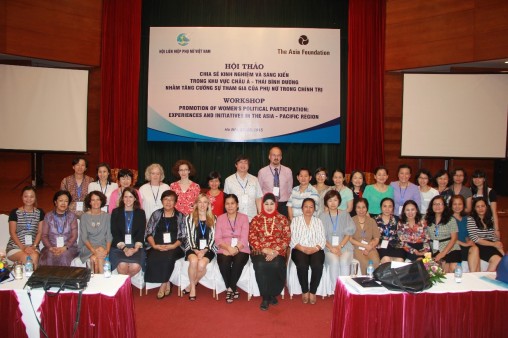
In 1930, the Indochinese Communist Party and the Women’s Emancipation Association (the precursor of the Women’s Union) were founded. Since then, the Communist Party has associated the struggle for women’s liberation and equality with nationalism and the liberation of the country from colonial powers. Because of this, the VWU has been in charge of mobilizing the female population throughout the country to join the anti-federalist and anti-imperialism movements organized by the Communist Party. This is visible in the use of different names for the Vietnam Women’s Union throughout the years: Liberalization Women’s Union (1931-45), the Anti-imperialism Women’s Union (1936-38), the Democratic Women’s Union (1939-40), and then the Women League for National Salvation (WLNS) (1950) In 1965, the VWU launched its first nationwide campaign directed to women called the “Three Responsibilities.” These were: to take care of the family, to take care of production, and to contribute to the war effort. Currently, this socio-political organization is affiliated with the Vietnam Fatherland Front, the Women’s International Democratic Federation and the Asian Confederation of Women’s Organizations (AWCO). The organization also works throughout the country at four administrative levels of central, provincial, district, and commune ones and has a total membership of above 13 million women.
“Facts and figures on women and men in Viet Nam 2010-2015.” United Nations Entity for Gender Equality and the Empowerment of Women (UN Women). Ha Noi, Vietnam, 2016. http://www2.unwomen.org/-/media/field%20office%20eseasia/docs/publications/2016/12/thuc-tien-ve-so-lieu-eng.pdf?la=en&vs=5823
Hội Liên hiệp Phụ nữ Việt Nam Viet Nam Women’s Union. http://hoilhpn.org.vn/newsdetail.asp?CatId=66&NewsId=819&lang=EN (accessed April 10, 2019).
Turley, William S. “Women in the Communist Revolution in Vietnam.” University of California Press 12, No. 9 (1972). DOI: 10.2307/2642829
Main Issues
Vietnam Women’s Union is mandated to protect women’s legitimate rights and strive for gender equality. One of its many goals is to raise the capacity and knowledge of women to advance toward full economic, educational, and political equality. The Union seeks to advance policy matters relating to families, women, and children and promotes women’s leadership. It addresses the issue of trafficking of women and children and proactively participates in the development of law and policy implementation related to gender equality. In terms of promoting women’s rights in economic, labor, and employment areas, it focuses on practical activities such as building housing for disadvantaged women and providing “loans for the development of production and business, building houses, buying means of production, assisting more than 2.7 million poor-female headed households in economic development, nearly 450,000 households of which have risen out of poverty” (Vietnam’s Women’s Union: Report On Ensuring And Promoting Women’s Rights, 5). VWU also organizes cross border workshops with Cambodia and China to promote bilateral cooperation.
“Vietnam Women’s Union (VWU).” The Asia Foundation, asiafoundation.org/projects/vietnam-womens-union-vwu/
“Vietnam Women’s Union.” Namati, namati.org/network/organization/viet-nam-womens-union/. 11, April 2019.
“Vietnam’s Women’s Union: Report On Ensuring And Promoting Women’s Rights.” Office of the United Nations High Commissioner for Human Rights. Ha Noi, Vietnam, 13 June 2013
Challenges
A major challenge that the VWU and other organizations face is the underlying strong Confucian values in Vietnamese culture. Within Vietnamese society, Confucianism continues to play a role in shaping individuals’ thinking (Chau, iv). One example of this is female infanticide and the belief that “only boys are worth keeping because boys help perpetuate the family name” (Rosenlee, 274). These Confucian values contribute to male preference. The gender prejudice prevalent in Vietnam has led to the sex imbalance at birth and female infanticide. Vietnam faces many difficulties in socioeconomic conditions, especially in rural, mountainous, remote, and isolated areas (VWU: Report On Ensuring and Promoting Women’s Rights). This leads to a lack of opportunity for rural women, ethnic minorities. For instance, it affects their ability to develop skills they need to meet the requirements of industrialization, modernization, and international integration. VWU has difficulty in adequately communicating the link between implementing gender mainstreaming, which is “a globally accepted strategy for promoting gender equality in research, legislation, and policy development,” and making development sustainable (un.org).
Chau, Mira Nguyen. “Vietnamese Migrants’ Attitudes towards Vietnamese Sexist Language .” University of Tasmania , 2006.
Rosenlee, Li-Hsiang Lisa. Confucianism and Women: a Philosophical Interpretation. SUNY, 2007.
“Vietnam’s Women’s Union: Report On Ensuring And Promoting Women’s Rights.” Office of the United Nations High Commissioner for Human Rights. Ha Noi, Vietnam, 13 June 2013
“Vietnam National Action Plan: The Questionnaire .” 1995.
“Welcome to the United Nations, It’s Your World.” United Nations, United Nations, www.un.org/.
Achievements
VWU has participated in the development and supervision of law and policy activities related to gender equality. The group focused on proposing changes to a number of draft laws (i.e. The Law on Adoption, the Law on Human Trafficking Prevention and Combat, etc.). It has also made continuous recommendations of policies related to women, family, and children, as well as being active in coordination with the judicial sector by providing women legal counseling and aid.
To ensure women’s rights in politics, VWU has developed action plans through consulting and finding effective female political candidates. As a result, the number of female members in Party Committees at the district levels and in the People’s Councils at all levels has increased.
VWU has also helped promote women’s rights in economic and employment areas by focusing on practical activities such as building housing for disadvantaged women (i.e. women with disabilities), creating movements like “Women’s mutual help in economic development” to decrease poverty, and providing support through vocational training and job creation. Between 2007 and 2012, members of VWU have helped construct and repair 10,713 houses for women with disabilities and helped more than 256,000 women entrepreneurs access loans. Furthermore, vocational training for women has been intensified nationwide.
Drawbacks
VWU still wishes to figure out a way to fight against the problems arising in the market economy, such as abortion, divorce, and HIV infection rates. Family service programs are still not meeting the demands of society. Currently, there are not enough kindergartens and schools in most of the industrial zones. Epidemics, natural disasters, food contamination, and environmental pollution are also damaging the quality of life for rural women, especially working in industrial zones. VWU also wishes to improve international cooperation to deal with problems related to women marrying foreigners (counseling, addressing human rights violations, ensuring conditions for marriage life, divorce issues, etc.).
Duong, Wendy N. “Gender Equality and Women’s Issues in Vietnam: The Vietnamese Woman—Warrior and Poet.” Pacific Rim Law and Policy Journal Association. Vol. 10 No. 2 https://digital.law.washington.edu/dspace-law/bitstream/handle/1773.1/783/10PacRimLPolyJ191.pdf?sequence=2
Targ, Harry. The Vietnam Women’s Union: An Effective Mass Organization. New Clear Vision,April19th,2011.http://www.newclearvision.com/2011/04/19/the-vietnam-women%E2%80%99s-union/
Vietnam Women’s Union. Report on Ensuring and Promoting Women’s Rights. Office of the United Nations High Commissioner for Human Rights, June 13, 2013. file:///Users/Sasha/Downloads/VWU_UPR18_VNM_E_Main.pdf
Relationship with the State
Vietnam is influenced by feudalism and has not completely escaped a patriarchal society. There are many values placed upon the relationships between the husband and wife, parents and children, and older and younger generations, which impede women’s autonomy (Hội liên hiệp Phụ nữ, 2005). The Vietnam Women’s Union was created to fight against the constraints on the livelihood of women and to implement social change in the lives of rural and urban Vietnamese women (Drummond, 2004).
The establishment of this group is dependent on the State where both the National Party and VWU have worked to create a blend of Marxist and traditional image of Vietnam (Luong, 2007). However, the enforcement of modernity and female empowerment has caused conflicting ideas of gender and other social priorities in the VWU (Pettus, 2004). In Vietnam, women live under the Three Obediences and Four Confucian Virtues of Femininity, which enforce gender identity, and struggle to promote equal rights and emancipation. These are: 1.obey your father before marriage, 2. obey your husband when married, and 3. obey your sons in widowhood. The Four Virtues of Femininity are: 1.female virtues, 2. female words, 3. female appearances, and 4. female work (Kelleher, 2005). Women are still struggling to find a place in a post-racial society where being independent is seen as rejecting family duties and traditional values (Drummond, 2004).
Drummond, L. (2004). The Modern Vietnamese Woman: Socialization and Women’s Magazines. In L. Drummond & H. Rydström (Eds.), Gender practices in contemporary Vietnam (pp. 158–179). Singapore: Singapore University Press.
Hội liên hiệp Phụ nữ – Việt nam (2005) “Basic Information on Vietnam Women’s Union”.
Kelleher, M. Theresa (2005). “San-ts’ung ssu-te”. In Taylor, Rodney L.; Choy, Howard Y.F. (eds.). The Illustrated Encyclopedia of Confucianism. 2 N-Z. New York: The Rosen Publishing Group. P. 496.
Luong, Hy V. (2007). “The Restructuring of Vietnamese Nationalism, 1954-2006”. Pacific Affairs. 80 (3): 439–453. Retrieved 26 November 2018.
Pettus, Ashley (2004). Between Sacrifice and Desire: National Identity and the Governing of Femininity in Vietnam. Routledge. pp. 1–16. ISBN 9781135945503.
