Background Information on Palestine
Introduction and Demographics
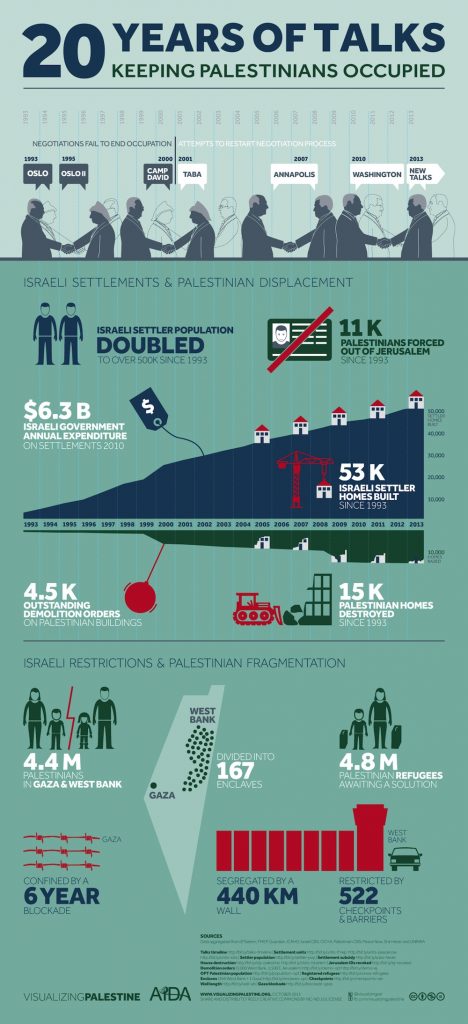
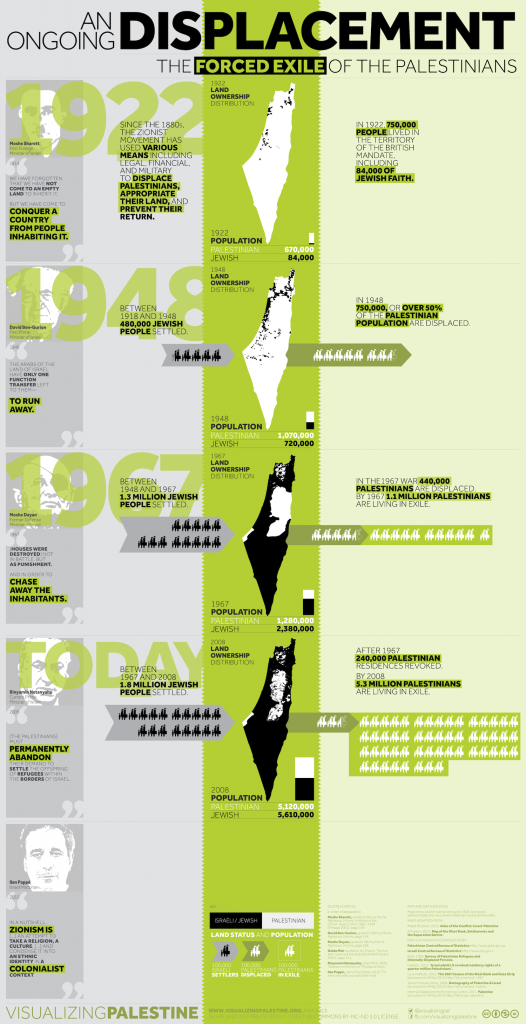
The Palestine-Israeli conflict is a struggle between the Zionist project that aimed at attaining a Jewish majority in Palestine and the native people of that land, the Palestinian Arabs. This conflict began with the Partition plan of 1947, which granted Jews statehood in 55 percent of Palestine, an area that included as many Arab residents as Jews. On May 15, 1948, with the establishment of the state of Israel, at least 726,000 of the 1.3 million Palestinian Arabs were forcibly removed from their homes by Zionist armed groups. This day is known as Nakba, or “catastrophe”, as it marks the ethnic cleansing of Palestinians and the destruction of more than 530 Palestinian villages and cities. (See https://www.aljazeera.com/indepth/features/2017/05/nakba-start-1948-170522073908625.html, https://www.palestineremembered.com/Acre/Palestine-Remembered/Story452.html, https://www.britannica.com/place/Palestine#ref45096). In 1967, the Israeli victory in the Arab-Israeli war led to another exodus of fleeing Palestinians. Despite several subsequent peace agreements, this conflict did not end there, the population of Palestine continues to suffer, and the ethnic cleansing of Palestinians continues to present day.
The two regions of Palestine vary slightly in demographics: the West Bank has a population of approximately 3 million, of which 80-85% are Muslim and 12-14% are Jewish, while the Gaza Strip has a population of approximately 2 million, of which 98-99% are Muslim. ( http://www.pcbs.gov.ps/Default.aspx ).
Political and Economic Context
The Palestinian economy has been greatly impacted by its relationship with Israel. Israel’s imposition of military and economic measures as part of its occupation of the West Bank and Gaza Strip have affected all aspects of the Palestinian economy, “resulting in long-term economic disequilibria and, in some cases, irreversible de-development.” (See https://unctad.org/en/PublicationsLibrary/gdsapp2011d1_en.pdf ). The struggles of the economy have led to high rates of poverty in Palestine, with 53% of individuals in the Gaza Strip and 13.9% of individuals in the West Bank living in poverty in 2017. ( http://www.pcbs.gov.ps/Document/pdf/txte_poverty2017.pdf?date=16_4_2018_2). Without an official government, the Palestinian Liberation Organization (PLO) is the leading political group, with the Palestinian National Authority as an agency of the PLO that represents Palestinians internationally. (https://www.bbc.com/news/world-middle-east-14630174 ).
Colonial and Post-Colonial Experiences
In many ways, Israel can be seen as a settler-colonial state, and Palestine is continuing to work towards its own decolonization. This colonial relationship between Israel and Palestine, especially as it is manifested in Israel’s occupation of Palestine, has greatly impacted all aspects of Palestinians’ lives. (https://libproxy.kenyon.edu/login?url=http://search.ebscohost.com/login.aspx?direct=true&db=a9h&AN=122900475&site=ehost-live, https://www.un.org/unispal/document/struggle-of-palestinians-directed-at-colonial-occupation-of-land-people-not-judaism-permanent-observer-tells-solidarity-meeting-press-release/ ).
Impact of Culture and the State on Women’s Movements
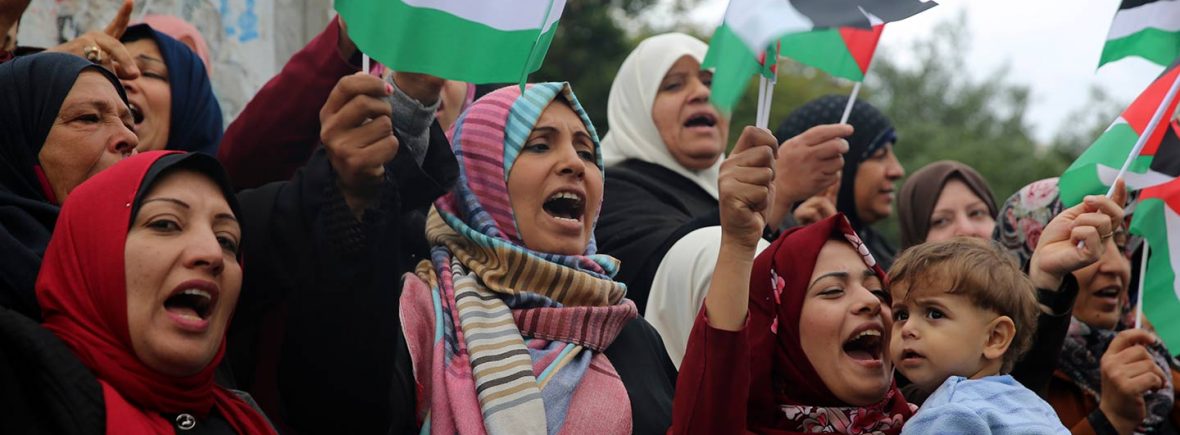
During the first intifada in the late 1980s and early 1990s, women began to form the backbone of the uprising and take up the cause for liberation. This newfound role in activism led to the emergence of an autonomous Palestinian women’s movement in the 1990s, and it then separated itself from the national movement and the leadership of the Palestine Liberation Organization (PLO). The women’s movement has had to contradict and criticize views and practices of the Islamic Resistance Movement, Hamas, as well as the PLO. Palestinian leadership has traditionally defined very strict roles and images for Palestinian women, and has always privileged national liberation over women’s liberation. (https://www.jstor.org/stable/190511, https://www.aljazeera.com/indepth/features/palestinian-women-led-successful-violent-resistance-180307133728630.html)
Relationship with the West
The West, including the United States, generally does not recognize Palestine as an official state. USAID has historically provided aid to the Palestinians, but under the current Trump administration this aid has been halted. (https://fas.org/sgp/crs/mideast/RL34074.pdf). The U.S. is also complicit in Israel’s human rights abuses of Palestinians. Under the Obama administration, annual military aid for Israel increased from 2.55 billion to 3.1 billion, and the U.S. provides more military aid to Israel than to any other state (https://www.aljazeera.com/indepth/interactive/2018/03/understanding-military-aid-israel-180305092533077.html ). In contrast to the position of the U.S. government, solidarity for Palestine has heightened among U.S. citizens in the past decade. Many U.S. based activist groups are commited to anti-imperialist and anti-colonial movement building, and they draw connections between the Palestinian struggle for self-determination and the freedom struggles of indigenous, black, and immigrant communities in the U.S.