Introduction and Demographics
The United States is a country founded on a system that suffers from a set of internal contradictions: democratic ideals and colonialism; the pursuit of freedom and slavery; the quest for self-determination and imperialism. The indigenous populations faced genocide and were forced to work on plantations. African people were brought to the Americas as slaves, and the women of this community were raped, nonconsensually experimented upon, and forced to face generations of injustice and cruelty. This foundational violence and exploitation of people of color continues to the present day. The term people of color is particularly used in the United States as a way to describe people who are not white, non-European. Hence, the term emphasizes the common experience of systemic racism.
Political and Economic Context
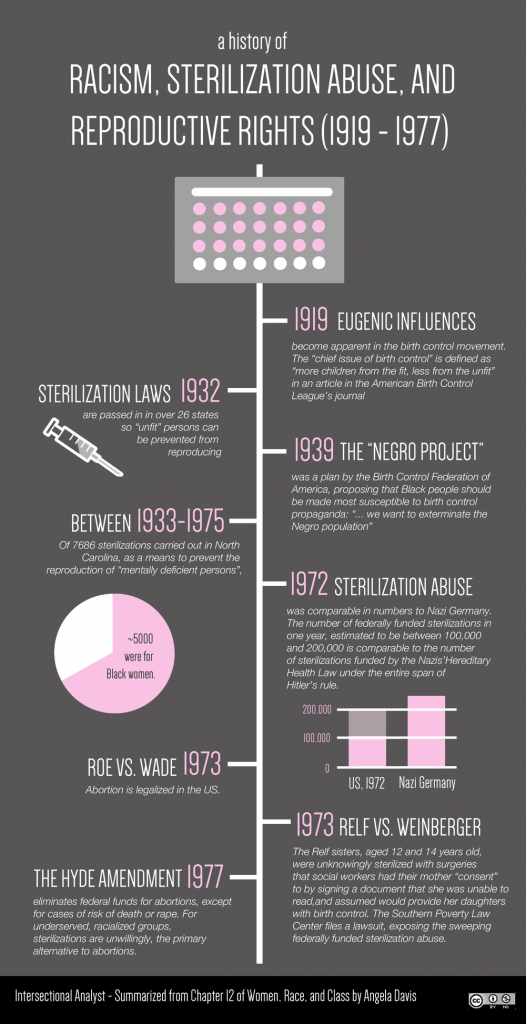
Systemic racism shackled people of color in a cycle of poverty through segregation and discriminatory practices. Though segregation became illegal after Brown vs. the Board of Education, “separate but equal” is inherently unequal. Further along in the history of the United States, integration was not enforced, leading in the 70s to laws resegregating communities. Cities such as New York encouraged middle class white families to move out of the cities into the suburbs, known as “white flight.” As these families moved out, neighborhoods lost property value, trapping people of color in low-income neighborhoods. This, in turn, limited economic opportunities and social mobility for people of color. They were deemed lazy and considered a damage to the American economy. As the population of people of color increased, health professionals and lawmakers targeted women of color, coercing them to be surgically sterilized. The belief was that by forcefully sterilizing women of color, this would reduce dependency on welfare and other public services. Overall, this was considered to be for the betterment of the American economy. Doctors would withhold information from women and advise them to be surgically sterilized despite this often being unnecessary.
Colonial and Post-Colonial Experiences
Forced sterilization was a form of recolonizing the bodies of women of color. During the colonial period,women of color were stripped of the opportunity of motherhood. Their children were sold as slaves, forced to assimilate through boarding schools, and often wrongfully killed in cold blood. These horrific events led to a movement for the empowerment of women of color based around having children and being a mother. By removing the right to bear children through forced sterilization, once again the U.S. colonized women of color.
Impact of Culture and State on Women’s Movements
In the 70’s and 80’s, U.S. the mainstream feminist movement focused on abortion rights culminating in Roe vs. Wade. Such movement, led by White women, did not recognize the struggles and experiences of women of color. Beyond reproductive right and abortion, feminists of color focused on reproductive justice.
Country’s Relationship with the West
Though generally U.S. women of color are considered part of the West, feminist of color have argued that ethnic, racial, and class discriminitation in the U.S. make their lived experiences comparable to those of Third World. Hence, Chela Sandoval speaks about U.S. Third World Feminism, or the Third World within a First World. Women of color struggled alone during the feminist/abortion movement in the 80’s. Nevertheless, Black and Hispanic women had their stories validated by sharing their experiences with forced sterilization and neglect within the healthcare system. They amplified their voices within the healthcare system to bolster the safety for other women of color.
